
MIT Puts a Tiny Ultrasound Speaker in Your Skull, and Honestly It's About Time Cancer Got Some Bad News
By Dakota Jones
Desk: Science, Health & Environment, Medical Research & Biotech.
Intro
A tiny ultrasound array, a drug-delivery channel, and a rechargeable battery: MIT researchers have combined them in an implantable device designed to help drugs spread through brain tissue. Its name is LUCID. Its ambition is to improve delivery where aggressive brain tumors can return.
That is promising. It is also early-stage research, not a treatment ready for patients, and not evidence that this device can stop cancer. The important distinction is not fine print. It is the story.
What Happened
On October 26, 2026, researchers in MIT’s Dagdeviren lab announced LUCID, short for Long-term Ultrasound-enhanced Convective Injection Device. The research, published in the journal Device (Cell Press), was led by senior author Canan Dagdeviren, an associate professor of media arts and sciences at MIT. The lead authors are MIT graduate student Sarah Ornellas and Jason Hou PhD ’26.
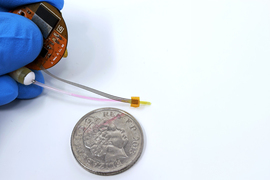
LUCID is a flexible implant as thin as a sheet of cardstock. A 3D-printed drug-delivery cannula sits directly on an array of 24 miniature ultrasound transducers. A reservoir holds about 100 microliters of fluid. A passive osmotic pump supplies the infusion; ultrasound is controlled wirelessly via Bluetooth, and a small battery can be recharged wirelessly.
In plain terms, the cannula delivers fluid locally, while the ultrasound is intended to help molecules travel farther through nearby tissue. The sound waves create convective flows, movement that helps spread molecules, and temporarily increase the permeability of the blood-brain barrier. That barrier protects the brain, but it can also make drug delivery there difficult. A little biological security is useful; getting medicine through it is the engineering challenge.
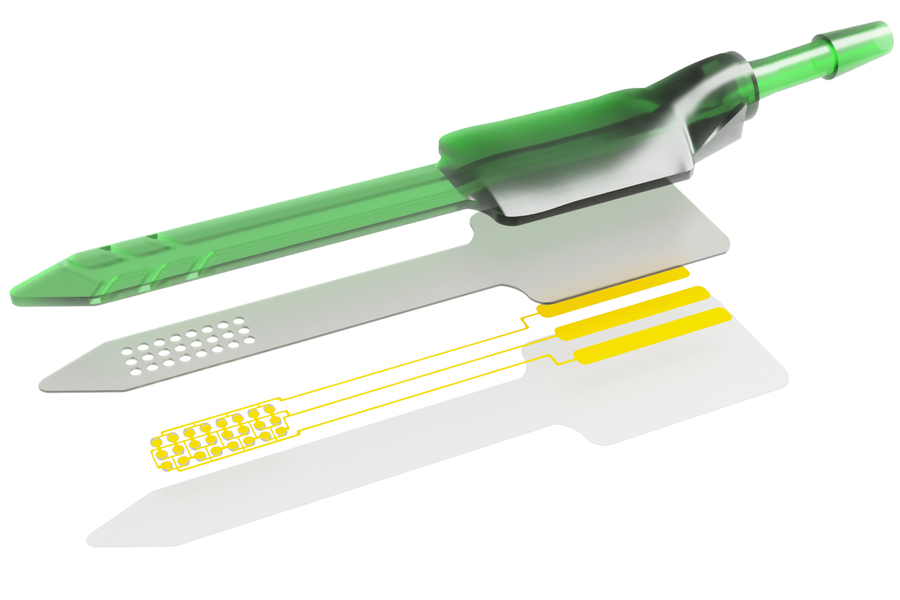
MIT illustration of LUCID’s integrated fluid-delivery channel and ultrasound array. Components are separated for illustration. Credit: MIT.
The researchers tested the system in a tissue phantom, a gel designed to mimic human tissue, and in mice using an MRI contrast agent. In both settings, the molecules spread farther when ultrasound was activated.
That is a measured result about distribution. It is not evidence that LUCID treated glioblastoma, improved survival, or worked in people. The device has not been tested in humans, and no efficacy against glioblastoma has been established.

Concept illustration of the proposed delivery principle, not an MRI scan, clinical result, or image of the actual MIT device.
Why It Matters
Glioblastoma is an aggressive brain cancer. The reported context is sobering: a little more than 10,000 U.S. cases per year, with average survival of 12 to 15 months after diagnosis. Tumors can recur because surgeons cannot remove every cancer cell.
The idea behind LUCID is to bring delivery and distribution together. Researchers hope that, if the device is developed for patients, it could be implanted during surgery. The cannula and ultrasound array would sit inside the skull; the electronics would remain outside. That arrangement is a potential design, not a current clinical procedure.
Why add ultrasound to a delivery system? Because getting a molecule into brain tissue and getting it to spread through that tissue are separate hurdles. LUCID is designed to address both locally: deliver fluid through the cannula, then use ultrasound to encourage wider distribution nearby. The early experiments support the distribution part in a gel model and mice. They do not establish what would happen in a human tumor.
The researchers also point to possible future uses beyond small-molecule drugs, including immunotherapies and nucleic acids, such as gene therapies, and potentially treatments in other organs. Those are possibilities, not proven applications. The work was funded by the MIT Media Lab Consortium and the National Institutes of Health.

Concept illustration of preclinical bench testing; not a photograph of MIT’s experiment.
FAQ: What You Should Know
Is LUCID a cancer treatment available to patients?
No. It has not been tested in humans.
Has it been shown to treat glioblastoma or prevent recurrence?
No. The reported tests measured how far molecules spread in tissue-mimicking gel and in mice. They did not establish cancer-treatment efficacy.
What does the ultrasound do?
It creates convective flows that can help molecules spread through nearby tissue and temporarily increase blood-brain barrier permeability.
What might be implanted?
If developed for patients, the cannula and ultrasound array would be inside the skull, while the electronics would be outside.
Verdict
LUCID is a clever, technically specific attempt to address a real drug-delivery problem: medicine may need help reaching and spreading through brain tissue. Its combination of a cannula, ultrasound array, passive pump, and wireless controls gives the approach a compelling rationale.
But the headline should not outrun the evidence. So far, this is an early-stage device tested in a tissue phantom and mice, not a demonstrated glioblastoma treatment, and not a human trial. The next meaningful question is whether the approach can prove safe and effective in the studies required before patients could benefit.
That is the good news, stated carefully. A promising engineering result is worth watching. It is not a cure, and calling it one would do patients no favors.
Sources
- MIT News, “Implantable device uses ultrasound to improve drug delivery to the brain”
- Medical Xpress (Science X Network, republishing MIT News with editorial review), “Implantable device uses ultrasound to improve drug delivery to the brain”