
Texas Just Cast 4.5 Million Ballots Before Halloween, and Somebody Spent $490 Million to Interrupt Them

By Dakota Jones
Desk: Political & Government, Campaigns & Elections.
Texas has already logged more than 4.5 million early ballots, and it is not even Halloween. Meanwhile, candidates and outside groups have poured roughly $490 million into a U.S. Senate race that is, according to several polls, essentially tied.
That is a lot of civic participation and an almost unfathomable amount of advertising. But the ballot total does not tell us who is winning. And campaign spending cannot buy certainty, no matter how many commercials insist otherwise.
Here is what the numbers show, what they do not show, and why this race has suddenly become a national political weather system.
What happened: millions voted early, and the Senate race tightened
As of Monday, October 26, Texas had recorded 4,538,667 early votes, according to unofficial figures from the Texas Secretary of State. That includes 4,332,753 in-person ballots and 205,914 mail ballots.
Against the state’s 19,041,684 registered voters, that is about 24 percent. Early voting is up 74 percent compared with the same point in the 2022 midterm cycle.
In-person early voting continues through Friday, October 30. Election Day is Tuesday, November 3.
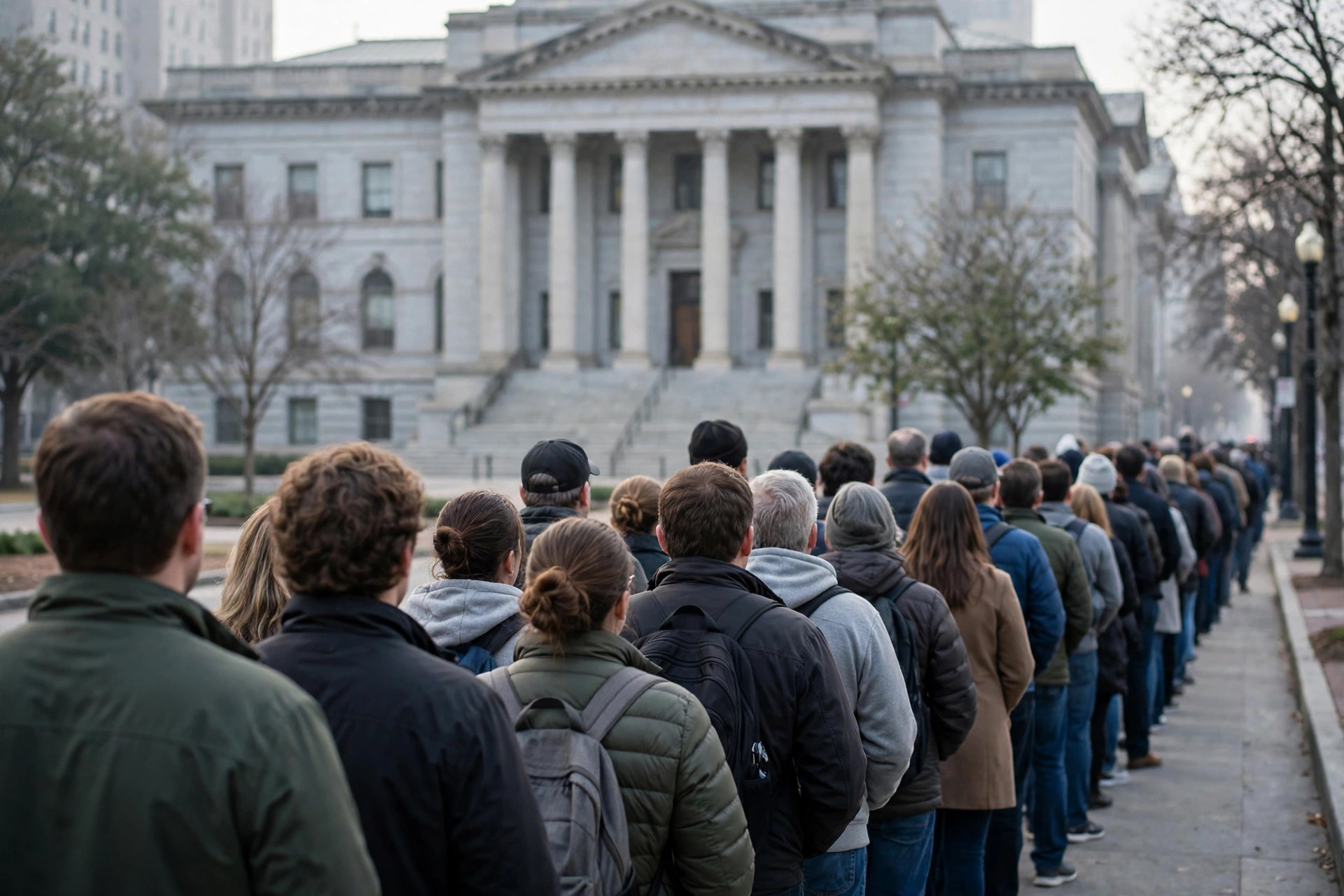
The turnout surge is unfolding alongside a remarkably close Senate contest between Democratic state Rep. James Talarico and Republican Attorney General Ken Paxton. That closeness is striking in a state where Democrats have not won a statewide race since 1994, 32 years ago.
The polling is tight enough to make the word “toss-up” feel less like pundit seasoning and more like a reasonable description:
- The RealClearPolitics average of surveys from October 8 to 21 had Talarico ahead 48.4 percent to 46.9 percent.
- A Fox News poll of likely voters, conducted October 15 to 19, had the candidates tied at 49 percent, with a margin of error of ±2.5 points.
- An Emerson College/Nexstar poll from October 17 to 19 gave Talarico 49 percent and Paxton 48 percent, with a margin of error of about ±3 points.
A one-point lead inside the stated margin of error is not a declaration of victory. It is a reminder that voters still have a say.

The money numbers are just as eye-catching. An October 12 AdImpact report put advertising spending across the primary, runoff and general election at $490.4 million, making this the second-most expensive nonpresidential race on record.
Elon Musk donated $158 million to the Senate Leadership Fund, which passed the same amount to Texas PAC, a major outside group backing Paxton. Musk also gave $10 million to the Lone Star Liberty PAC.
Talarico wrote on X, “Elon Musk is trying to buy this Senate seat in Texas... He's trying to buy Texas.” Paxton posted on October 21, “This race is TIED! This race is a dead heat, and every bit of support matters.”
A Senate seat is not a collectible. But the ad budget is apparently trying very hard to make it look like one.
Why it matters: turnout is a clue, not a result
The ballot count tells you how many people have voted, not how they voted. Texas does not register voters by party, so claims about the early electorate’s partisan makeup depend on modeling rather than official party totals.
One model estimated the early vote at 46 percent Republican, 44 percent Democratic and 10 percent other. That two-point difference is not a verdict. It is well within the uncertainty that comes with modeling a state that does not record voters by party.
University of Kentucky political science professor D. Stephen Voss told Newsweek that voters turn out in large numbers when they believe a contest is close. He also cautioned that Republicans should pay attention to a possible Democratic enthusiasm advantage seen in special elections since President Trump returned to office.
County figures offer a useful view of the scale, with an important reporting caveat. Harris County topped 624,000 ballots through Sunday, according to ABC13, as cited by Space City Daily. The Secretary of State’s file through Sunday listed Harris at 579,313, with counties still filing and updating totals. That same state file listed Dallas County at 371,806 and Tarrant County at 337,084. The Harris figures are not directly interchangeable: the state file was lagging the county-reported count.

For voters, the practical lesson is simple: do not treat turnout as a poll. If you have not voted, check your registration, confirm your polling information with official election sources, and make a plan before early voting ends Friday.
For anyone following the campaign, the lesson is similarly basic: be wary of confident claims that the early vote “belongs” to either party. A ballot count is a count, not a partisan receipt.
That distinction matters in any election coverage. LD3 Productions’ Trust-First approach puts a premium on clear sourcing and careful context, while its distribution platforms help audiences find content where they watch.
Quick questions
Does 4.5 million early votes mean one candidate is ahead?
No. The total measures ballots cast, not candidate choice.
Can we tell from the official tally how many Republicans or Democrats voted?
No. Texas does not register voters by party. Party-share estimates are modeled.
Verdict: Texas is competitive, but the count is not a crystal ball
Texas has a major early-voting surge, a Senate race polls show within a point or two, and $490.4 million in reported ad spending. That combination makes this a consequential contest, not a foregone conclusion.
The number to watch right now is not just how many Texans have voted. It is whether the campaigns can persuade the remaining voters to show up, and whether the final ballots confirm the close race the polls are describing.
Until then, the honest verdict is also the least satisfying one: the race is close, turnout is high, and nobody gets to call the result early just because they bought a lot of airtime.
Sources
- Texas Secretary of State, Early Voting Totals Archive
- Newsweek, “What Record-Breaking Texas Early Voting Says About the Talarico vs. Paxton Race” (October 26, 2026)
- Space City Daily, “Texas Early Voting Passes 4.53 Million Ballots as the Final Week Opens; Harris County Tops 624,000” (October 26, 2026)